Why Convergence Studies Matter
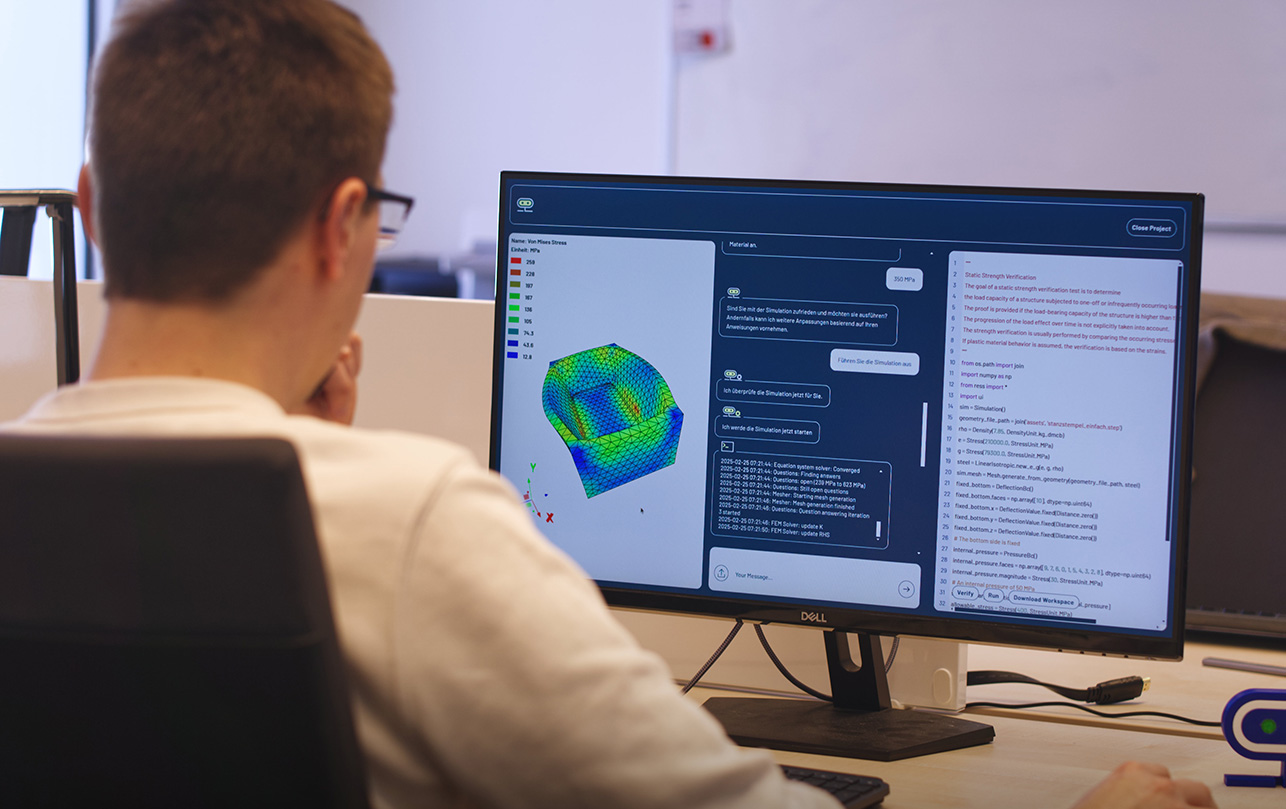

Why Convergence Studies Matter
How to make better decisions with well-founded simulations – and why this is especially crucial for small and medium-sized enterprises.
Introduction: When Numbers Mislead
Engineers and designers rely daily on simulation results to make important decisions: Will a component hold? Is an optimization economically viable? Yet what appears on the screen as an exact number – such as stress calculated to five decimal places – is in reality only an approximation. Both simulations and measurements are never perfect, but always just a representation of reality.
The problem: Without knowing how accurate this approximation is, even the best decision can become a gamble. This is exactly where convergence studies come into play.
Why Every Simulation Needs Validation
The goal of every simulation is a quantitative result that serves as a basis for decision-making – for example, whether a yield strength is exceeded. However, the simulation only provides an approximation of reality. Without knowing how close it is to the exact value, there is no reliable foundation for making sound decisions.
Many engineers initially validate their simulations using intuition – “does the component deform in the expected direction?” – which is a valuable plausibility check. But robust decisions require quantitative validation. This is achieved through:
- Experimental validation, e.g. with strain gauges
- A-posteriori error estimators based on the solution itself
- Convergence studies comparing simulations with different mesh densities
Convergence Studies: The Backbone of Reliable Simulations
A convergence study examines how the result changes as the mesh is refined. If the result remains stable, this is a strong indication of a convergent and therefore trustworthy solution.
Without this verification, things can become dangerous: A flawed convergence study creates a false sense of security – one assumes the result is exact, even though it may only appear stable by coincidence. This is riskier than conducting no study at all.
Studies show that up to 40% of industrial FEM analyses are performed without sufficient convergence verification. The consequences:
- Wrong decisions due to overly coarse meshes
- Loss of trust in simulations
- Cost explosions due to overly conservative safety factors
- Unnecessary computation times from overly fine meshes – and thus wasted energy
After all, you wouldn’t use a 40-ton truck just to go to the bakery.
Experience Alone Is Not Always Enough
In many companies, mesh generation is based on experience: “This is how it has always been done.” This knowledge is valuable – but not transferable when new materials, load cases, or geometries come into play. Numerous dissertations spend years investigating the optimal meshing strategy for just a single component – highlighting the complexity of the topic.
Even expert knowledge reaches its limits when boundary conditions change. Systematic, data-driven approaches help objectively assess simulation quality.
Why This Is Especially Relevant for SMEs
Large companies invest heavily in validation, testing, and simulation processes. Small and medium-sized enterprises (SMEs), on the other hand, often operate with limited resources. This frequently leads to pragmatic but risky shortcuts – such as relying on default mesh settings or intuition.
Yet SMEs, in particular, stand to gain significantly:
- Reduced misjudgments through transparent accuracy
- Shorter development times through targeted mesh optimization
- More sustainable computations with lower energy consumption
- Greater acceptance of simulation results within management
Investing in convergence studies therefore pays off quickly – economically, technically, and ecologically.
How Dr.Q Supports
Dr.Q helps engineers and developers better understand error bounds, model quality, and convergence – in an automated, transparent, and efficient way.
Our solutions enable quantitative validation of simulation results without requiring extensive expert time for manual mesh analysis. This transforms uncertain estimation back into well-founded decision-making.
Conclusion: Trust Through Understanding
Simulations are powerful tools – but only if their limitations are understood. A number with five decimal places is not a guarantee of truth, but often just a comforting illusion.
Convergence studies are therefore not a luxury, but a fundamental requirement for credible simulations. Those who master them not only make better decisions, but also build trust – in their models, their processes, and their results.